Author Guidelines
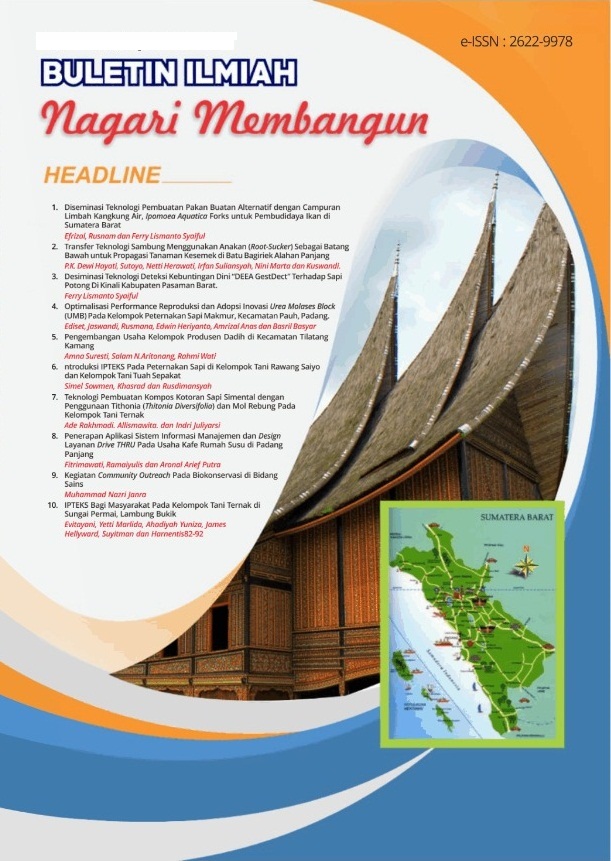
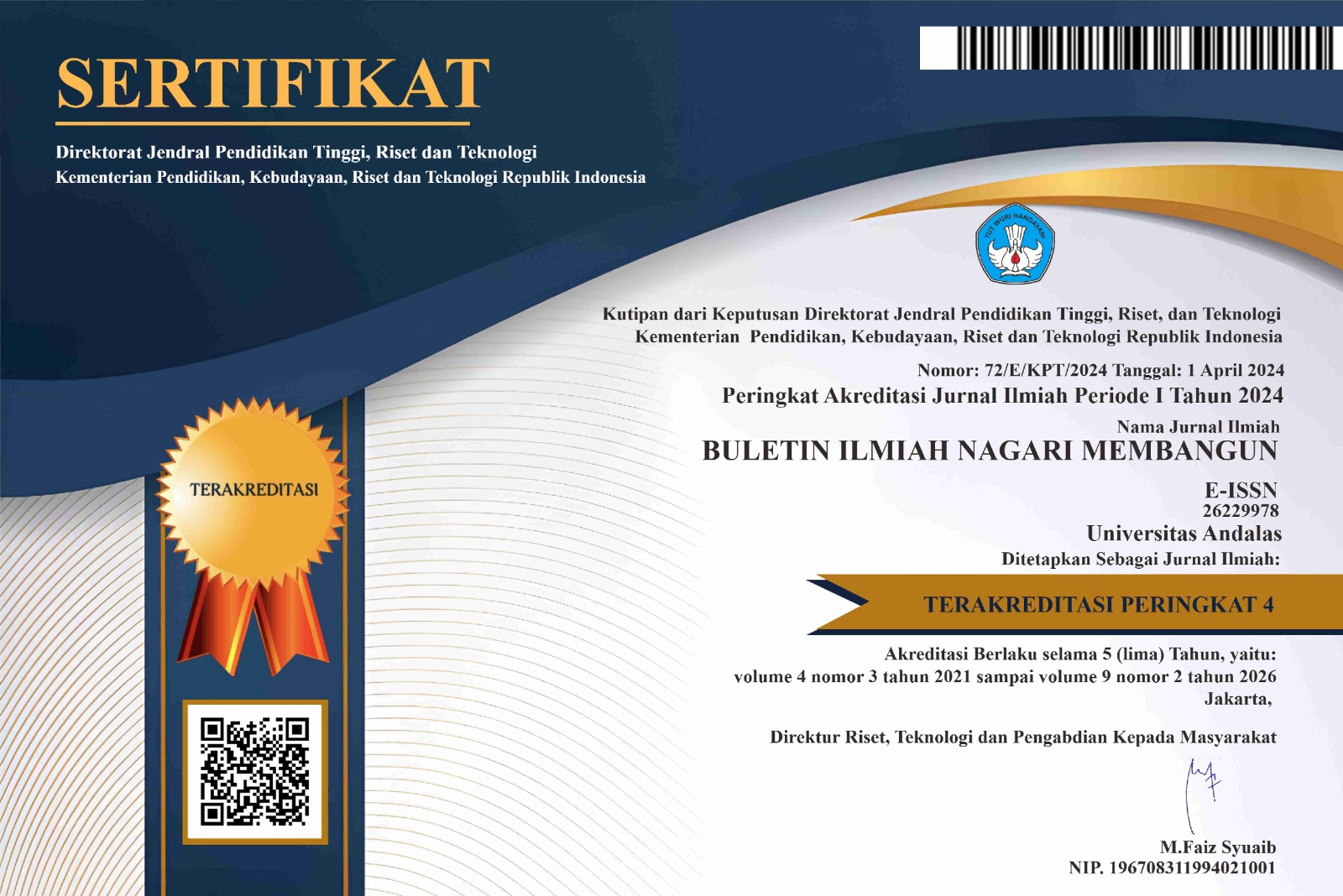
Buletin Ilmiah Nagari Membangun
1. General Information
Buletin Ilmiah Nagari Membangun publishes scholarly articles reporting community service, community engagement, community empowerment, and the application of knowledge, science, and technology to address community needs.
Authors must ensure that manuscripts are relevant to the journal's Focus and Scope and present original, accurate, ethically conducted, and appropriately documented scholarly work.
All submissions are subject to initial editorial screening and, when considered suitable, the journal's double-blind peer-review process.
Submission does not guarantee acceptance or publication.
Official journal website:
https://buletinnagari.lppm.unand.ac.id/index.php/bln
Online submission:
https://buletinnagari.lppm.unand.ac.id/index.php/bln/about/submissions
2. Manuscript Types
2.1 Community Service Article (Pengabdian kepada Masyarakat)
The journal accepts scholarly articles reporting the implementation, evaluation, and outcomes of community service or community engagement activities.
A Community Service Article should describe an actual activity undertaken to address an identified community problem, need, or development challenge.
The manuscript should present:
-
The community context and problem addressed.
-
The objectives of the activity.
-
The target community or partner institution.
-
The methods and implementation procedures.
-
The location, time, and duration of the activity.
-
The results or outputs of the intervention.
-
Evidence supporting the reported outcomes.
-
Discussion of achievements, limitations, and relevant scholarly literature.
-
Conclusions and recommendations.
Examples include community education, training, mentoring, technology transfer, public health promotion, environmental programs, local economic development, and other community empowerment initiatives.
Manuscripts must demonstrate a meaningful scholarly or practical contribution beyond merely describing that an activity took place.
2.2 Manuscript Categories Not Yet Established
The journal's current Author Guidelines identify articles concerning community service activities as its manuscript category.
Separate acceptance of review articles, systematic reviews, case reports, short communications, opinion articles, or other categories has not been established in these guidelines.
Such categories should not be advertised as accepted manuscript types unless formally approved by the editorial board and supported by specific author instructions.
Editorial announcements and other journal information should not automatically be classified as peer-reviewed scholarly articles.
3. Focus and Scope
Manuscripts must be relevant to the journal's community engagement and development orientation.
Relevant subject areas include:
-
Community empowerment.
-
Education and learning development.
-
Food security.
-
Public health.
-
Social development and community welfare.
-
Creative economy and entrepreneurship.
-
Preservation of local culture and indigenous knowledge.
-
Human resource development.
-
Dissemination and application of science and appropriate technology.
-
Innovation and technological development for communities.
The journal welcomes interdisciplinary contributions when they demonstrate clear relevance to community engagement and practical societal benefit.
4. Language Requirements
Manuscripts should be written in Bahasa Indonesia, with appropriate use of English scientific terminology where necessary.
Authors must provide:
-
A title in Bahasa Indonesia.
-
A title in English.
-
An abstract in Bahasa Indonesia.
-
An abstract in English.
-
Keywords in Bahasa Indonesia.
-
Keywords in English.
Authors are responsible for ensuring that translations preserve the original scholarly meaning.
The use of generative AI for translation or substantive language assistance must comply with the journal's Generative AI Policy.
5. General Manuscript Formatting
Manuscripts must follow the journal's established formatting requirements.
| Element | Requirement |
|---|---|
| Paper size | A4 |
| Margins | 3.0 cm on all sides |
| Main font | Times New Roman |
| Main text size | 12 pt |
| Line spacing | Single |
| Manuscript length | 8–15 pages, including references and attachments |
| File format | Microsoft Word |
| Submission platform | Journal OJS |
| Reference style | APA |
Figures and tables should appear in appropriate positions within the manuscript rather than being collected only at the end.
Authors must follow the official journal template when one is provided.
6. Manuscript Title
The manuscript must contain titles in Bahasa Indonesia and English.
The title should:
-
Be specific and informative.
-
Reflect the main activity or contribution.
-
Clearly indicate the subject of the manuscript.
-
Consist of 15–20 words in accordance with the journal's existing instructions.
-
Avoid unnecessary abbreviations.
Indonesian title:
-
Uppercase letters.
-
Bold.
-
Times New Roman, 12 pt.
-
Single-spaced.
English title:
-
Capitalized title words.
-
Bold.
-
Times New Roman, 12 pt.
-
Single-spaced.
The title must not exaggerate the results or impact of the reported community engagement activity.
7. Author Names and Affiliations
Author names must appear below the manuscript title in the version prepared for publication.
Authors must provide:
-
Full names without academic titles.
-
Institutional affiliations.
-
Email addresses.
-
The corresponding author's contact information.
The established formatting requirements are:
-
Author names and affiliations: Times New Roman, 11 pt.
-
Email addresses: Times New Roman, 10 pt.
Names should not be unnecessarily abbreviated.
All listed authors must satisfy the journal's Authorship and Contributorship policy.
The order of authors must be agreed upon before submission.
8. Manuscript Anonymization
The journal uses double-blind peer review.
Authors should prepare an anonymized manuscript file for review.
The review version should exclude unnecessary information that directly identifies the authors, including author names, affiliations, and identifying acknowledgments.
Author information should be supplied separately through OJS or another method authorized by the editorial office.
Authors must maintain accurate citations and ethical disclosures while preparing the anonymized manuscript.
9. Abstract
The manuscript must contain abstracts in Bahasa Indonesia and English.
Each abstract must:
-
Contain 200–250 words.
-
Be written as one paragraph.
-
Be single-spaced.
-
Use Times New Roman, 10 pt.
-
Be justified.
-
Follow the journal's established paragraph indentation requirements.
The abstract should clearly summarize:
-
The community problem or need.
-
The objective of the activity.
-
The implementation method.
-
The principal results or outcomes.
-
The conclusion.
The abstract must not present unsupported claims of effectiveness or long-term impact.
10. Keywords
Authors must provide 3–5 keywords in Bahasa Indonesia and English.
Keywords should accurately represent the manuscript's principal subjects, methods, and community engagement context.
Authors should select terms that improve discoverability and are consistent with the content of the manuscript.
11. Manuscript Structure
The main manuscript should follow the structure established in the journal's existing writing instructions:
-
Introduction.
-
Methods.
-
Results and Discussion.
-
Conclusions and Recommendations.
-
Acknowledgments, if applicable.
-
References.
Additional declarations required by the journal may be provided in appropriate sections or supplementary submission files.
12. Introduction
The Introduction should explain the context and justification for the community engagement activity.
Authors should describe:
-
The relevant community or target group.
-
The community problem, challenge, or need.
-
Factual information supporting the identification of the problem.
-
Relevant previous interventions or scholarly work.
-
The rationale for the proposed activity.
-
The expected contribution.
-
The objective of the community engagement activity.
The Introduction should be concise, evidence-based, and supported by appropriate references.
The objectives should be stated clearly at the end of the section.
13. Methods
The Methods section must explain how the community engagement activity was designed, implemented, and evaluated.
Authors should describe:
13.1 Community and Activity Location
Identify the target community, partner organization, or relevant institutional setting.
13.2 Time and Duration
State when the activity was conducted and its duration.
13.3 Problem-Solving Approach
Explain the method or intervention used to address the identified community problem.
13.4 Implementation Procedures
Describe the principal stages of implementation, such as preparation, coordination, training, mentoring, demonstration, implementation, and evaluation, as applicable.
13.5 Participants and Community Partners
Describe the target participants and the roles of community partners, while respecting privacy and consent requirements.
13.6 Data Collection Techniques
Explain the procedures used to collect observations, evaluation information, or other relevant evidence.
13.7 Data Analysis and Evaluation
Describe how the collected information was analyzed or used to evaluate the activity.
13.8 Ethical Considerations
Describe relevant permissions, consent procedures, confidentiality safeguards, or ethics approvals when applicable.
Methods should be sufficiently clear to allow readers to understand and critically assess the activity.
14. Results and Discussion
This section must report the actual implementation and outcomes of the community engagement activity.
Authors should address the following components.
14.1 Implementation Results
Explain which activities were implemented and how they corresponded to the stated objectives.
14.2 Outputs
Describe relevant outputs, such as:
-
Educational materials.
-
Training programs.
-
Skills development.
-
Products or equipment.
-
Appropriate technology.
-
Community services.
-
Organizational improvements.
-
Other tangible or intangible outputs.
14.3 Outcome Evaluation
Present evidence of the outcomes achieved.
Where appropriate, this may include observations, assessments, participant feedback, pre- and post-activity measurements, or other documented findings.
14.4 Interpretation
Explain what the findings mean in relation to the original community problem.
14.5 Comparison With Relevant Literature
Compare the findings critically with relevant theories, previous community engagement studies, or scholarly publications.
14.6 Strengths and Limitations
Discuss the strengths, implementation challenges, limitations, and factors affecting the results.
14.7 Sustainability and Practical Implications
Where relevant, explain the potential continuation, application, or adaptation of the program.
Authors must distinguish clearly between observed outcomes and anticipated longer-term benefits.
15. Tables, Figures, and Equations
Tables and figures must be relevant, legible, and appropriately referenced in the manuscript.
Tables:
-
Number tables consecutively.
-
Place table titles above the tables.
-
Center table titles.
-
Follow the journal's established table formatting, including its instruction not to use left and right table borders.
Figures:
-
Number figures consecutively.
-
Place captions below figures.
-
Center figure captions.
-
Ensure that images are sufficiently clear for publication.
Equations:
Mathematical equations should be prepared using Microsoft Equation or an equivalent application and numbered appropriately.
Authors must obtain necessary permissions for third-party material.
Photographs showing identifiable individuals must comply with applicable consent and privacy requirements.
AI-generated illustrations must not be misrepresented as documentary evidence of actual activities.
16. Conclusions and Recommendations
This section should:
-
Answer the stated objectives.
-
Summarize the principal achievements.
-
Explain the relevance of the results to the community's needs.
-
Identify practical benefits supported by the evidence.
-
Provide appropriate recommendations for future community engagement activities.
The section must be written in paragraph form without numbered subsections.
Authors should avoid introducing new statistical results or unsupported claims in the conclusion.
17. Acknowledgments
Acknowledgments, where applicable, must appear before the References section.
Authors may acknowledge:
-
Funding organizations.
-
Supporting institutions.
-
Community partners.
-
Technical contributors.
-
Individuals providing assistance who do not meet authorship criteria.
Acknowledgments must not be used to grant honorary authorship.
Where appropriate, authors should obtain permission before naming individuals.
18. References and Citation Style
The journal uses the American Psychological Association (APA) reference style.
Authors must comply with the following established requirements:
-
Include at least 10 references.
-
Ensure that at least 70% of references are primary scientific journal sources.
-
Follow the journal's requirement concerning sources published within the preceding 10 years.
-
Cite all sources accurately.
-
Ensure that every in-text citation corresponds to a reference entry.
-
Ensure that every listed reference is relevant to the manuscript.
Authors are encouraged to use reference management software such as Mendeley, Zotero, RefWorks, or EndNote.
References must not be fabricated.
Authors must independently verify bibliographic information, particularly when using AI-assisted tools.
19. Originality and Previous Publication
Submitted manuscripts must be original scholarly contributions.
Manuscripts must not be under simultaneous consideration by another journal.
Authors must disclose relevant previous dissemination, substantial overlap, or related publications.
The journal's Repository Policy permits preprints and distinguishes preprint dissemination from prior formal journal publication.
Authors who have posted a preprint should disclose its existence and provide the relevant URL or identifier.
Plagiarism, redundant publication, data fabrication, and inappropriate reuse of previously published content are prohibited.
20. Authorship and Contributorship
All authors must have made qualifying scholarly contributions and must approve the submitted manuscript.
Authors should provide accurate contribution information when requested.
Individuals who provide assistance but do not qualify for authorship should be acknowledged appropriately.
Generative AI systems cannot be listed as authors.
Authorship disputes or changes must be handled according to the journal's Authorship and Contributorship policy.
21. Ethical Approval, Consent, and Community Participation
Authors must comply with applicable ethical requirements.
Ethical approval should be obtained where required by the nature of the activity, relevant regulations, or institutional requirements.
Not every community engagement activity necessarily requires formal research ethics committee approval.
Authors must obtain appropriate informed consent and publication consent where applicable.
Special attention must be given to:
-
Vulnerable participants.
-
Minors.
-
Identifiable photographs.
-
Personal and sensitive information.
-
Confidential community records.
-
Community or institutional permissions.
-
Indigenous or culturally sensitive knowledge.
Authors must not disclose confidential information without an appropriate basis.
22. Data Availability and Supporting Evidence
Authors should provide sufficient information to support the credibility of reported activities and findings.
Where applicable, supporting evidence may include:
-
Evaluation data.
-
Observation records.
-
Questionnaires.
-
Training assessment results.
-
Implementation documentation.
-
Analytical procedures.
-
Other appropriate evidence.
Authors should provide a Data Availability Statement when required by the editorial office.
Sensitive or confidential data must not be made publicly available when disclosure would violate ethical, legal, or privacy requirements.
23. Funding Statement
Authors should disclose relevant funding sources and institutional support.
Where applicable, the funding statement should identify the funding organization and relevant grant information.
Authors should also disclose whether the funder had a role in the activity design, data analysis, manuscript preparation, or publication decision.
If no external funding was received, authors may provide an appropriate statement indicating this.
24. Conflicts of Interest
Authors must disclose financial, institutional, professional, or personal interests that could reasonably influence the reported work.
Potential conflicts may include commercial interests, institutional relationships, or direct interests in products and services discussed in the manuscript.
The absence of conflicts of interest should be stated when required by the journal.
25. Generative AI Disclosure
Authors must comply with the journal's Generative AI Policy.
Material use of generative AI in manuscript preparation, analysis, translation, or content generation must be disclosed.
The disclosure should identify the tool, its purpose, and the relevant human verification.
Authors remain responsible for the accuracy, originality, and integrity of all AI-assisted content.
Generative AI must not be used to fabricate community engagement activities, data, images, references, or evaluation results.
26. Copyright and Open Access
Authors retain copyright in their published scholarly contributions in accordance with the journal's published copyright arrangements.
The journal's published articles are distributed under the Creative Commons Attribution-ShareAlike 4.0 International License (CC BY-SA 4.0).
The license permits sharing and adaptation, including commercial reuse, subject to attribution and ShareAlike conditions.
Authors must ensure that third-party materials can lawfully be published and reused under the applicable arrangements.
27. Repository and Self-Archiving
The journal permits authors to deposit the following manuscript versions in appropriate scholarly repositories:
-
Submitted Version (Preprint).
-
Accepted Version (Author Accepted Manuscript).
-
Published Version (Version of Record).
The journal's Repository Policy does not impose an additional self-archiving embargo.
Authors should identify manuscript versions accurately and link repository records to the final published article when available.
28. Submission Procedure
Manuscripts must be submitted through the official OJS platform:
https://buletinnagari.lppm.unand.ac.id/index.php/bln/about/submissions
Authors should:
-
Register or log in to the journal's submission system.
-
Review the Author Guidelines and relevant publication policies.
-
Prepare the manuscript in the required format.
-
Provide complete and accurate submission metadata.
-
Upload the manuscript and required supporting files.
-
Complete the submission checklist.
-
Provide relevant declarations and disclosures.
-
Confirm the submission through OJS.
The corresponding author is responsible for monitoring editorial communication and coordinating responses from all authors.
29. Required Submission Documents
Authors must submit the manuscript and the originality statement required by the journal.
Depending on the manuscript and applicable editorial requirements, additional documentation may include:
-
A separate author information or title-page file.
-
An anonymized manuscript for peer review.
-
Author contribution information.
-
Funding and conflict-of-interest declarations.
-
Generative AI disclosure.
-
Ethical approval or consent information, where applicable.
-
Supporting data or supplementary files, where appropriate.
The editorial office should specify which documents are mandatory for all submissions and which are required only in relevant circumstances.
30. Peer-Review Process
The journal applies double-blind peer review.
Manuscripts undergo initial editorial screening before external review.
Reviewers evaluate scholarly merit, relevance, methodological quality, supporting evidence, ethical compliance, and the contribution of the work.
Authors may be requested to revise their manuscripts.
Final editorial decisions are made by authorized editors and are independent of publication fees.
Further information is available in the journal's Peer-Review Processes policy.
31. Manuscript Revision
Authors receiving a revision decision should respond carefully to editorial and reviewer comments.
A revised submission should include:
-
The revised manuscript.
-
A clear response to substantive comments.
-
An explanation of changes made.
-
Scholarly justification for recommendations not adopted.
Revision does not guarantee acceptance.
Authors must not make unsupported changes to data or results merely to satisfy reviewer preferences.
32. Article Processing Charges
The journal's published Article Processing Charge is:
IDR 500,000 per accepted article.
The APC is payable after formal acceptance.
Payment does not guarantee acceptance or favorable editorial treatment.
Authors should consult the official fee policy before submission:
https://buletinnagari.lppm.unand.ac.id/index.php/bln/Article_Processing_Charges
33. Manuscript Withdrawal
Authors should carefully consider their intention to publish before submitting a manuscript.
The journal's published fee policy identifies a withdrawal fee of IDR 350,000 when a manuscript is withdrawn on or after the commencement of peer review.
Authors should consult the official withdrawal conditions and contact the editorial office when withdrawal is necessary.
Legitimate publication ethics concerns must be handled according to the journal's relevant policies.
Withdrawal of an unpublished manuscript is distinct from correction or retraction of a published article.
34. Post-Publication Responsibilities
Authors must cooperate in addressing credible concerns about published work.
Where significant errors are identified, authors should inform the editorial office.
The journal may issue corrections, expressions of concern, or retractions where justified under its publication ethics policies.
Authors remain accountable for the accuracy and integrity of their published contributions.
35. Submission Preparation Checklist
Before submitting, authors should confirm that:
-
The manuscript is relevant to the journal's Focus and Scope.
-
The manuscript reports an appropriate community service or community engagement activity.
-
The manuscript is original and is not under simultaneous consideration by another journal.
-
Any relevant preprint or previous dissemination has been disclosed.
-
All authors have approved the manuscript.
-
The manuscript is 8–15 pages and follows the required formatting.
-
The titles and abstracts are provided in Bahasa Indonesia and English.
-
Keywords are provided in both languages.
-
The manuscript follows the required section structure.
-
Tables, figures, and references comply with the journal's instructions.
-
The references follow APA style and meet the journal's requirements.
-
An originality statement is provided.
-
Required ethical, funding, conflict-of-interest, and AI disclosures have been prepared.
-
The review file has been anonymized where required.
-
The authors understand the published APC and withdrawal conditions.
36. Editorial Contact
Editorial Office
Buletin Ilmiah Nagari Membangun
Lembaga Penelitian dan Pengabdian kepada Masyarakat (LPPM)
Universitas Andalas
Padang, West Sumatra, Indonesia
Email: nagari.lppm@unand.ac.id
Alternative email: nagari.lppm.unand@gmail.com
Website: https://buletinnagari.lppm.unand.ac.id/index.php/bln
37. Related Journal Policies
Authors should consult the following policies:
-
Publication Ethics and Policies.
-
Authorship and Contributorship.
-
Conflicts of Interest.
-
Data and Reproducibility.
-
Ethical Oversight.
-
Intellectual Property.
-
Plagiarism Policy.
-
Open Access Policy.
-
Peer-Review Processes.
-
Repository Policy.
-
Generative AI Policy.
-
Post-Publication Discussions and Corrections.
These policies form part of the journal's requirements for responsible manuscript preparation, submission, review, and publication.