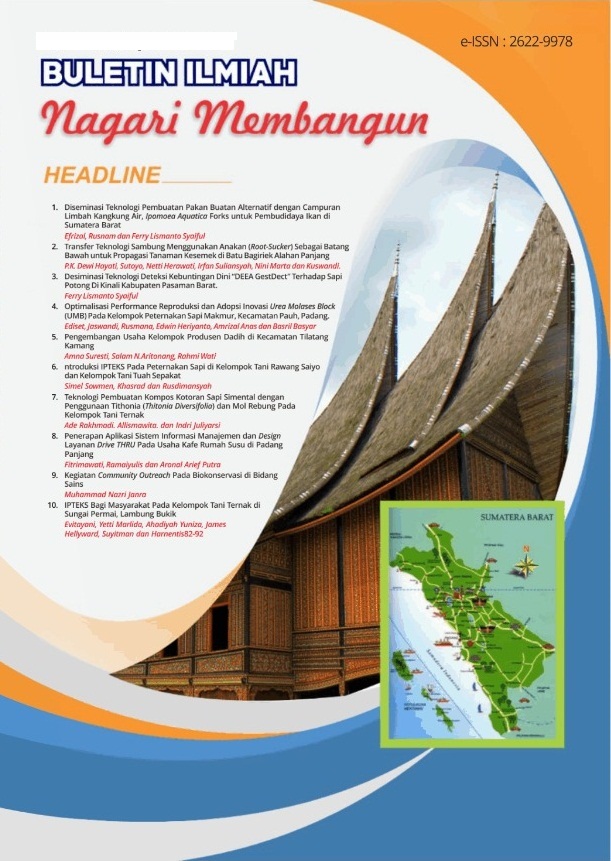
Journal Management
1. Policy Statement
Buletin Ilmiah Nagari Membangun is committed to transparent, responsible, independent, and sustainable journal management.
The journal seeks to maintain a reliable scholarly publishing environment that supports the dissemination of peer-reviewed community engagement and community development scholarship.
Its management practices are guided by the principles of the Committee on Publication Ethics (COPE) Core Practices and the Principles of Transparency and Best Practice in Scholarly Publishing.
This policy describes the journal's governance, editorial responsibilities, operational procedures, financial transparency, ethical commitments, and approach to maintaining the scholarly record.
2. Journal Ownership and Publisher
Buletin Ilmiah Nagari Membangun is published by:
Lembaga Penelitian dan Pengabdian kepada Masyarakat (LPPM)
Universitas Andalas
Padang, West Sumatra, Indonesia
Official website: https://buletinnagari.lppm.unand.ac.id/index.php/bln
The publisher supports the journal's institutional and operational needs, while editorial decisions must remain independent and based on scholarly and ethical considerations.
The journal's ownership, publisher identity, editorial structure, and contact information should be clearly presented on its official website.
3. Editorial Independence
The journal is committed to editorial independence.
Decisions concerning manuscript acceptance, rejection, revision, correction, expression of concern, or retraction must be based on relevant scholarly and ethical considerations.
These considerations include:
-
Relevance to the journal's aims and scope.
-
Originality and contribution to community engagement scholarship.
-
Quality and clarity of the manuscript.
-
Appropriateness of the methods and supporting evidence.
-
Reliability of the reported outcomes.
-
Compliance with publication ethics requirements.
-
Recommendations obtained through an appropriate peer-review process.
Editorial decisions must not be improperly influenced by authors' academic positions, institutional affiliations, financial contributions, personal relationships, or external pressure.
The publisher's administrative or financial support must not compromise the integrity of editorial decisions.
4. Editorial Governance Structure
The journal's editorial governance should provide clear responsibility for scholarly quality, publication ethics, manuscript handling, and editorial operations.
The structure may include:
-
Editor-in-Chief.
-
Editors or section editors.
-
Editorial board members.
-
Reviewers.
-
Editorial and production support personnel.
-
Publisher representatives responsible for institutional and operational support.
The journal should publish the current names, roles, and institutional affiliations of its editorial personnel.
Any additional governance positions should reflect the journal's actual organizational structure.
5. Responsibilities of the Editor-in-Chief
The Editor-in-Chief is responsible for overseeing the integrity and quality of the journal's editorial processes.
Responsibilities include:
-
Providing leadership in editorial policy and scholarly standards.
-
Ensuring that manuscripts are assessed fairly and consistently.
-
Overseeing the application of peer-review procedures.
-
Managing or delegating manuscript-related editorial decisions.
-
Identifying and managing relevant conflicts of interest.
-
Coordinating responses to publication ethics concerns.
-
Ensuring that corrections, expressions of concern, and retractions are considered when appropriate.
-
Supporting the development and review of journal policies.
-
Maintaining appropriate communication with the publisher.
The Editor-in-Chief should not handle a manuscript when a material conflict of interest compromises independent judgment.
In such cases, responsibility should be assigned to an appropriately independent editor.
6. Responsibilities of Editors and Editorial Board Members
Editors and editorial board members should support the journal's scholarly standards and publication ethics commitments.
Their responsibilities may include:
-
Assessing the relevance and suitability of submitted manuscripts.
-
Recommending appropriately qualified reviewers.
-
Evaluating reviewer reports and author responses.
-
Providing editorial recommendations within their assigned responsibilities.
-
Identifying potential ethical concerns.
-
Maintaining manuscript confidentiality.
-
Disclosing conflicts of interest.
-
Supporting improvements in editorial policies and practices.
Editorial personnel should act objectively and professionally.
They must not use confidential manuscript information for unauthorized personal, academic, or financial benefit.
7. Appointment and Evaluation of Editorial Personnel
The selection of editorial personnel should consider relevant scholarly expertise, experience, professional integrity, and commitment to the journal's aims and scope.
The journal should seek appropriate representation of expertise relevant to community engagement, community development, and the disciplines covered by its publications.
The publisher and editorial leadership should establish clear procedures for appointments, role descriptions, and periodic review of editorial participation.
The journal should avoid presenting honorary names as active editorial board members when those individuals do not perform an identifiable editorial role.
Changes in editorial membership should be reflected accurately on the journal website.
Specific appointment authorities, terms of office, and renewal procedures should be documented according to the journal's actual governance arrangements.
8. Peer-Review Management
The journal implements a double-blind peer-review process, in which the identities of authors and reviewers are concealed from one another as part of the review procedure.
The editorial team is responsible for ensuring that manuscript assessment is appropriate, impartial, confidential, and consistent with the journal's published procedures.
Reviewers should be selected on the basis of relevant expertise and their ability to provide independent scholarly assessments.
Reviewers must disclose material conflicts of interest and maintain the confidentiality of manuscripts.
The editorial team should evaluate reviewer recommendations critically rather than treating them as automatic editorial decisions.
Detailed procedures are provided in the journal's Peer-Review Processes policy.
9. Editorial Workflow and Publication Operations
The journal uses Open Journal Systems (OJS) to support its online publishing operations.
The editorial workflow generally includes:
-
Manuscript submission.
-
Initial administrative and editorial screening.
-
Assessment of relevance and compliance with submission requirements.
-
Peer-review assignment and evaluation.
-
Editorial decision and author revision, where applicable.
-
Final editorial assessment.
-
Copyediting and production.
-
Publication and dissemination.
-
Post-publication record maintenance.
The journal should maintain clear procedures for each stage and provide appropriate communication to authors and reviewers.
Operational responsibilities should be assigned to authorized editorial personnel.
10. Financial Model and Publication Fees
The journal operates under an open-access publishing model and publishes information about applicable author fees on its official website.
The journal's published fee information identifies:
-
An Article Processing Charge (APC) of IDR 500,000 for accepted articles.
-
A withdrawal fee of IDR 350,000 for manuscript withdrawal on or after the commencement of peer review, as stated in the journal's existing fee information.
All fees and their conditions must be disclosed transparently before authors submit manuscripts.
The journal should clearly distinguish between manuscript submission, editorial assessment, acceptance, publication, and withdrawal procedures.
Payment must not guarantee acceptance, favorable peer-review outcomes, or preferential editorial treatment.
Any changes to fees or payment conditions should be communicated through the official journal website.
Fee policies must be administered consistently with the journal's publication ethics responsibilities and applicable legal and institutional requirements.
In particular, financial arrangements must not obstruct legitimate corrections, expressions of concern, retractions, or the reporting and resolution of publication misconduct.
11. Open Access and Licensing
Buletin Ilmiah Nagari Membangun provides open access to its published scholarly content.
Published articles are distributed under the Creative Commons Attribution-ShareAlike 4.0 International License (CC BY-SA 4.0), as indicated in the journal's article publication records.
This license permits sharing and adaptation, including commercial reuse, subject to the applicable attribution and ShareAlike conditions.
The journal should ensure that copyright and licensing information is clearly and consistently displayed on article pages, published files, and relevant policy pages.
Further details are provided in the Open Access Policy and Intellectual Property policy.
12. Publication Ethics and Editorial Integrity
The journal is committed to maintaining appropriate procedures for handling publication ethics concerns.
These include:
-
Plagiarism and overlapping publication.
-
Fabrication and falsification.
-
Authorship disputes.
-
Conflicts of interest.
-
Peer-review manipulation.
-
Breaches of confidentiality.
-
Ethical approval and informed consent concerns.
-
Data reliability concerns.
-
Complaints and appeals.
-
Post-publication corrections and retractions.
-
Misuse of generative artificial intelligence.
Editors should follow the journal's published policies and consult relevant COPE guidance when appropriate.
Allegations must be assessed fairly and should not be treated as established misconduct without appropriate evidence.
13. Conflicts of Interest in Journal Management
Editorial personnel must disclose interests that could compromise, or reasonably appear to compromise, their impartiality.
Potential conflicts may arise from:
-
Personal or family relationships.
-
Institutional or supervisory relationships.
-
Recent or ongoing research collaborations.
-
Financial or commercial interests.
-
Academic rivalry or professional competition.
-
Direct involvement in a submitted manuscript.
A conflicted editor must not exercise sole responsibility for evaluating or deciding the affected manuscript.
Manuscripts submitted by editors or editorial board members should be handled through an appropriately independent editorial process.
The journal's Conflicts of Interest policy provides further requirements.
14. Website Transparency and Public Information
The official journal website should provide accurate, accessible, and regularly reviewed information concerning:
-
Journal title and publisher.
-
Aims and scope.
-
Editorial team and affiliations.
-
Author guidelines and submission procedures.
-
Peer-review process.
-
Publication ethics and policies.
-
Copyright and licensing.
-
Article processing charges and other applicable fees.
-
Publication frequency.
-
Contact information.
-
Archiving and preservation arrangements.
-
Indexing and abstracting information, where applicable.
Claims concerning indexing, accreditation, affiliations, and journal performance must be accurate and verifiable.
The journal should avoid misleading statements about acceptance guarantees, editorial turnaround times, impact metrics, or external endorsements.
15. OJS System Administration and Information Security
The journal should maintain appropriate administrative and technical safeguards for its OJS platform.
These should address:
-
Authorized user access and role permissions.
-
Protection of author, reviewer, and editorial account information.
-
Secure handling of submitted manuscripts and confidential correspondence.
-
Appropriate software maintenance and updates.
-
Backup and recovery arrangements.
-
Protection against unauthorized modification or deletion of records.
-
Procedures for responding to technical incidents.
-
Preservation of essential editorial and publication metadata.
The journal should coordinate relevant technical responsibilities with its publisher or authorized institutional IT personnel.
Specific claims concerning automated backup frequency, server security configurations, or disaster recovery arrangements should be published only after verification.
16. Privacy and Confidentiality
The journal is responsible for handling personal information obtained through submission, peer review, editorial correspondence, and website operations appropriately.
Access to confidential manuscripts and editorial records should be restricted to authorized individuals with legitimate responsibilities.
Reviewers and editors must not disclose unpublished manuscript content without appropriate authorization.
Personal information should be collected and used only for legitimate journal purposes and in accordance with applicable privacy requirements.
The journal should maintain an accessible privacy statement explaining its handling of personal information.
17. Editorial Training and Professional Development
The journal should support the professional development of editors, reviewers, and editorial support personnel.
Relevant areas include:
-
Publication ethics and COPE guidance.
-
Editorial independence.
-
Peer-review quality.
-
Conflicts of interest.
-
Research and community engagement ethics.
-
Data integrity and reproducibility.
-
Responsible use of generative AI.
-
OJS editorial workflows.
-
Corrections and retractions.
-
Copyright, licensing, and digital preservation.
Training and guidance should be proportionate to the journal's resources and operational needs.
18. Advertising, Sponsorship, and Direct Marketing
Advertising, sponsorship, and promotional activities must not compromise editorial independence.
If the journal accepts advertising or sponsorship, relevant arrangements should be disclosed transparently and advertising should be clearly distinguishable from editorial content.
Sponsors or advertisers must not influence manuscript acceptance, peer-review outcomes, or publication ethics decisions.
Calls for papers and other promotional communications should be accurate, professional, and not misleading.
The journal should not make unsupported claims about indexing status, acceptance rates, publication speed, or scholarly recognition.
Whether the journal currently accepts advertising or commercial sponsorship should be stated only after confirmation by the publisher and editorial office.
19. Digital Archiving and Preservation
The journal recognizes the importance of preserving published articles, metadata, and relevant publication records over the long term.
The journal should establish and document an appropriate digital preservation strategy.
Possible arrangements include institutional preservation systems or recognized third-party services, subject to actual enrollment, technical configuration, and successful content deposit.
The journal must not claim participation in a preservation network or service unless that participation and its operational status have been verified.
The Archiving Policy should identify the preservation arrangements actually in use, including the scope of preserved content and relevant responsibilities.
Website availability and routine server backups should not be presented as equivalent to independently verified long-term digital preservation.
20. Continuity and Sustainability
The publisher and editorial leadership should consider measures to support the journal's long-term continuity.
These may include:
-
Maintaining appropriate editorial staffing.
-
Preserving published content and metadata.
-
Documenting essential operational procedures.
-
Maintaining secure access to journal infrastructure.
-
Establishing arrangements for changes in editorial leadership.
-
Planning for technical failures or service interruptions.
-
Providing appropriate communication to authors and readers when significant operational changes occur.
If the journal changes publisher, migrates its platform, suspends publication, or ceases operations, reasonable measures should be taken to protect the scholarly record and communicate the change transparently.
Specific succession and preservation arrangements should be established and documented by the publisher.
21. Journal Performance and Quality Improvement
The journal should periodically evaluate its editorial and operational performance.
Relevant indicators may include:
-
Submission and publication volumes.
-
Editorial processing times.
-
Peer-review participation and quality.
-
Publication schedule adherence.
-
Frequency and nature of complaints.
-
Post-publication corrections.
-
Website and metadata quality.
-
Compliance with published editorial policies.
Any publicly reported statistics should be accurate, clearly defined, and based on verifiable records.
Performance indicators should support quality improvement rather than encourage inappropriate pressure to accept or publish manuscripts.
22. Policy Review and Accountability
The journal's editorial leadership and publisher should periodically review its governance arrangements, editorial procedures, and public policies.
Policy revisions should address changes in scholarly publishing standards, publication ethics guidance, technical infrastructure, and applicable institutional or legal requirements.
Significant changes affecting authors and readers should be communicated through appropriate official channels.
The journal should maintain consistency between its published policies and actual editorial practice.
23. Contact Information
Questions concerning journal management, editorial governance, or publication policies may be directed to:
Editorial Office
Buletin Ilmiah Nagari Membangun
Lembaga Penelitian dan Pengabdian kepada Masyarakat (LPPM)
Universitas Andalas
Padang, West Sumatra, Indonesia
Email: nagari.lppm@unand.ac.id
Alternative email: nagari.lppm.unand@gmail.com
Website: https://buletinnagari.lppm.unand.ac.id/index.php/bln
24. Related Policies and References
This policy should be read alongside the journal's:
-
Publication Ethics and Policies
-
Allegations of Misconduct
-
Authorship and Contributorship
-
Complaints and Appeals
-
Conflicts of Interest
-
Data and Reproducibility
-
Ethical Oversight
-
Intellectual Property
-
Peer-Review Processes
-
Post-Publication Discussions and Corrections
-
Archiving Policy
-
Open Access Policy
-
Repository Policy
-
Generative AI Policy
References
-
Committee on Publication Ethics (COPE). Core Practices. https://publicationethics.org/core-practices
-
COPE, DOAJ, OASPA, and WAME. Principles of Transparency and Best Practice in Scholarly Publishing. https://publicationethics.org/
-
Committee on Publication Ethics (COPE). Ethics Toolkit for a Successful Editorial Office. https://publicationethics.org/